

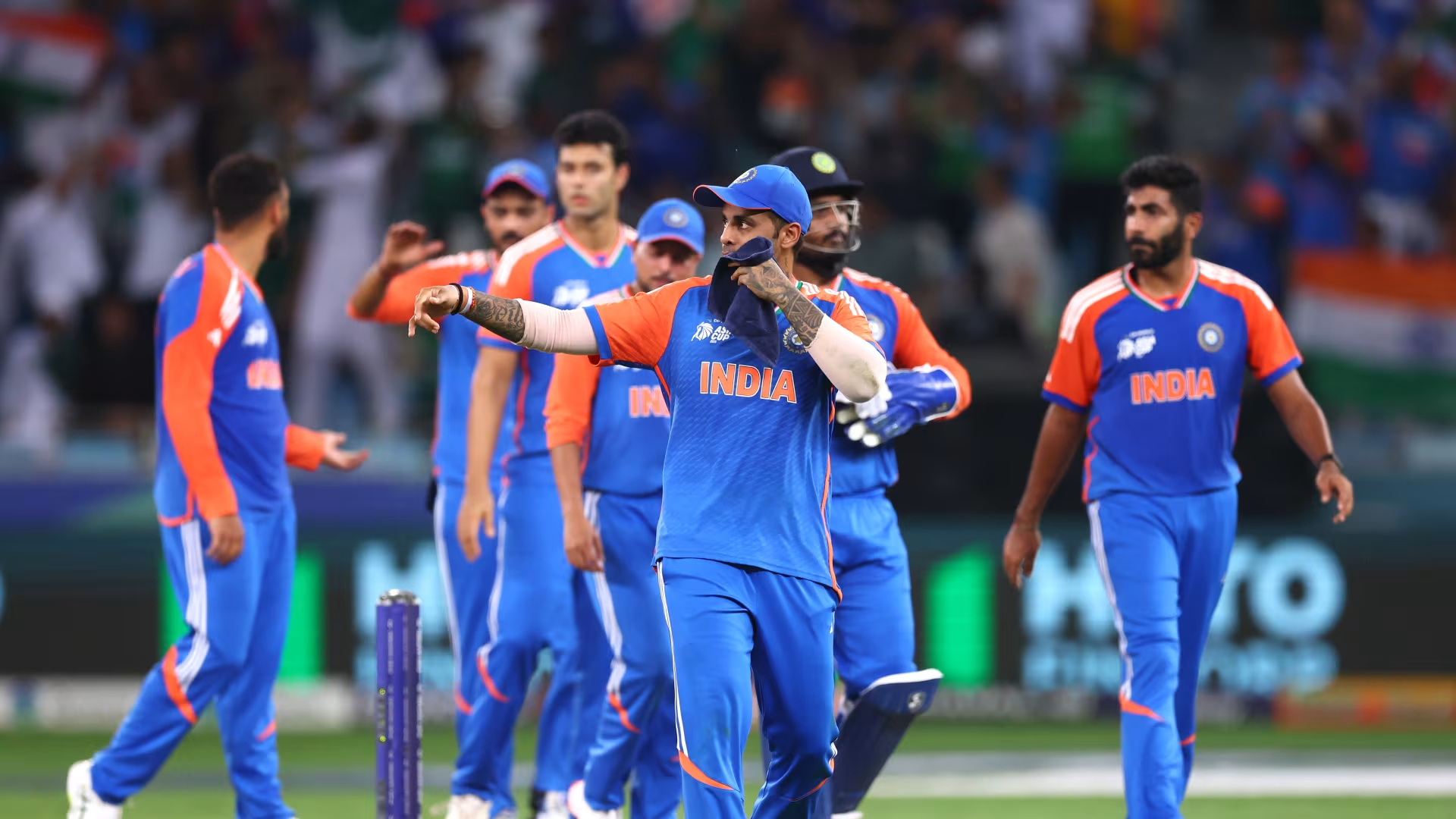
Few sporting institutions anywhere in the world command the cultural authority that the India national cricket team holds within its own country and increasingly across global cricket’s competitive landscape. The Tigers — more commonly known simply as Team India — are simultaneously the sport’s most commercially significant entity, its most passionate supporter base, and increasingly its most consistently competitive force across all three formats. Understanding india cricket requires engaging with the achievements that have built this position, the schedule demands that sustain it, and the challenges that the next competitive cycle presents. Fans following every India match with dedicated markets can find comprehensive coverage at dbbet.
The Foundation: How India Became Cricket’s Dominant Force
India national cricket team history begins humbly — the inaugural Test match against England in 1932 delivered a loss that reflected genuine developmental inequality between colonial subject and established Test nation. The journey from that starting point to the current era, where India’s home conditions are considered among cricket’s most formidable competitive environments and where the team’s results across all formats reflect genuine world-class quality, represents one of sport’s most complete national competitive transformations.
The specific milestones that marked this transformation carry their own narrative weight. The 1983 World Cup victory under Kapil Dev — winning as rank outsiders against the West Indian powerhouse that had defined limited-overs cricket’s first decade — demonstrated that Indian cricket could compete and win on the global stage when conditions aligned. The 2007 T20 World Cup victory under Mahendra Singh Dhoni’s young captaincy delivered the format’s inaugural championship. The 2011 ODI World Cup triumph on home soil completed the ICC trophy collection in the format that India’s commercial power had made its own. Each achievement built on the previous, creating the competitive confidence that current players inherit as institutional expectation rather than aspirational horizon.
Virat Kohli and the Standard-Setting Era
No individual has shaped modern Indian cricket’s competitive identity more completely than Virat Kohli — whose batting excellence, fitness standards, and competitive intensity collectively transformed how the Indian team understood the requirements of international cricket at the highest level.
His Test batting record across overseas conditions — historically the specific area where Indian batsmen’s technical limitations against quality seam bowling had been most visible — demonstrated that subcontinental batting excellence could translate into genuine world-class performance in England, Australia, and South Africa. The specific quality of his technique under genuine pace and swing challenged the assumptions that had defined Indian batting’s international limitations across previous generations.
Beyond personal achievement, Kohli’s influence on the team’s fitness culture — bringing conditioning standards closer to those of sporting cultures where athletic preparation is treated as foundational rather than supplementary — created the physical platform that the current generation of Indian players builds upon as baseline rather than aspiration.
Rohit Sharma’s Captaincy and the Current Generation
Rohit Sharma’s leadership of the Indian national team across formats represents a continuation of the specific competitive standards that Kohli’s era established while expressing a different captaincy personality — more tactically flexible in public expression, more comfortable delegating responsibility within the team structure, and specifically effective at managing the psychological environment that India’s enormous pressure context creates for players across every match.
The 2024 T20 World Cup victory — delivering India’s second T20 world championship under Rohit’s captaincy — provided the specific ICC tournament success that the current generation’s talent had been suggesting was achievable across several near-miss tournament cycles. The win’s significance extended beyond the trophy into validating the team’s ability to perform under maximum pressure when the competitive opportunity aligned with the preparation quality that the team’s development had been building toward.
The current generation’s batting depth — the combination of Rohit, Kohli, Shubman Gill, Shreyas Iyer, and the supporting cast whose quality creates genuine competition for batting positions — represents the richest talent accumulation in Indian cricket’s history across any generation’s comparable career phase.
India Cricket Schedule: The Demands of Modern International Cricket
India cricket schedule management has become one of cricket’s most discussed organizational challenges — the combination of bilateral series obligations across all formats, ICC tournament cycles, and the IPL’s domestic calendar creates annual scheduling demands that no other cricket nation faces at comparable intensity.
India’s international schedule reflects the BCCI’s commercial and diplomatic relationships across cricket’s global structure — home series against England, Australia, South Africa, and the subcontinent’s neighbors providing the broadcast revenues that fund the entire ecosystem, while overseas tours fulfill the bilateral obligations that international cricket’s relational framework requires. The specific challenge of managing player workloads across this schedule — rotating squads strategically, managing injury prevention alongside competitive performance requirements, and maintaining the competitive intensity that India’s fans expect regardless of scheduling context — is the organizational challenge that the BCCI and coaching staff navigate continuously.
The ICC’s Future Tours Programme provides the structural framework within which India’s schedule operates — determining which bilateral series occur in which years and creating the planning horizon that squad development decisions require. Managing the transition between Test cricket’s extended format demands and the T20 and ODI competitions that follow requires the squad depth that India’s current talent pipeline provides more comprehensively than any previous generation.
Test Cricket: India’s Evolving Home Fortress
India’s home Test record represents one of cricket’s most formidable competitive environments — the specific combination of turning pitches prepared to maximize spin bowling effectiveness and the specifically skilled batting that subcontinental conditions develop creates an environment where visiting teams have historically found sustained competitiveness genuinely difficult to maintain.
England’s Bazball approach under Ben Stokes and Brendon McCullum has provided the most serious recent challenge to India’s home Test dominance — their 2024 series produced competitive cricket that demonstrated touring teams could genuinely threaten India’s home record when approach, technique, and competitive mentality aligned to meet subcontinental conditions’ specific challenges with aggression rather than survival intent.
Overseas Test cricket remains the specific area where India’s ambition most authentically meets the sport’s highest competitive standard — the Border-Gavaskar Trophy contests against Australia and the England series provide the competitive contexts that define Test careers in ways that home series dominance cannot fully substitute for within global cricket’s competitive evaluation framework.
Jasprit Bumrah: The Bowling Excellence That Changes Everything
Jasprit Bumrah’s emergence as the world’s most complete fast bowler across formats has provided India with a specific competitive weapon whose effectiveness in all conditions — the traditional limitation that subcontinental pace bowlers faced in overseas environments — has reshaped how opponents plan their approach to Indian bowling attacks.
His action’s specific characteristics — the unusual loading position, the wrist position at release, and the ability to reverse swing older balls alongside conventional swing with newer ones — create challenges for batting analysis that most opponents cannot fully neutralize regardless of preparation quality. His effectiveness in the death overs of limited-overs cricket alongside his Test match wicket-taking frequency demonstrates versatility across formats that genuinely great bowlers possess and good bowlers cannot sustain.
Managing Bumrah’s workload — protecting the specific physical demands his bowling action creates across the schedule intensity that India’s cricket calendar presents — represents the specific cricket management challenge that the BCCI and team management treats as the highest priority within their squad planning.
The Next Competitive Cycle: Challenges and Ambitions
India cricket’s competitive ambitions across the next ICC cycle reflect a team whose talent depth justifies genuine championship expectations across all three formats — the combination of batting quality, Bumrah’s bowling excellence, and the spin resources that India’s conditions continuously produce creates the technical foundations that tournament success requires.
The specific challenge the next generation presents is the transition management that follows whenever a generational cohort of elite performers approaches their careers’ conclusion simultaneously. How India manages the transition beyond Kohli and Rohit’s eventual retirement — identifying and developing the captaincy leadership and batting foundations that sustain competitive quality across generational transitions — will determine whether the current era’s achievements represent a peak or the foundation of a sustained competitive dynasty.
The 2027 ODI World Cup hosted in South Africa and the continuing T20 World Cup cycles provide the specific competitive targets around which the next planning cycle organizes — creating the aspirational framework that squad development decisions reference and against which the next generation’s readiness to carry India cricket’s competitive standards forward will ultimately be assessed.
